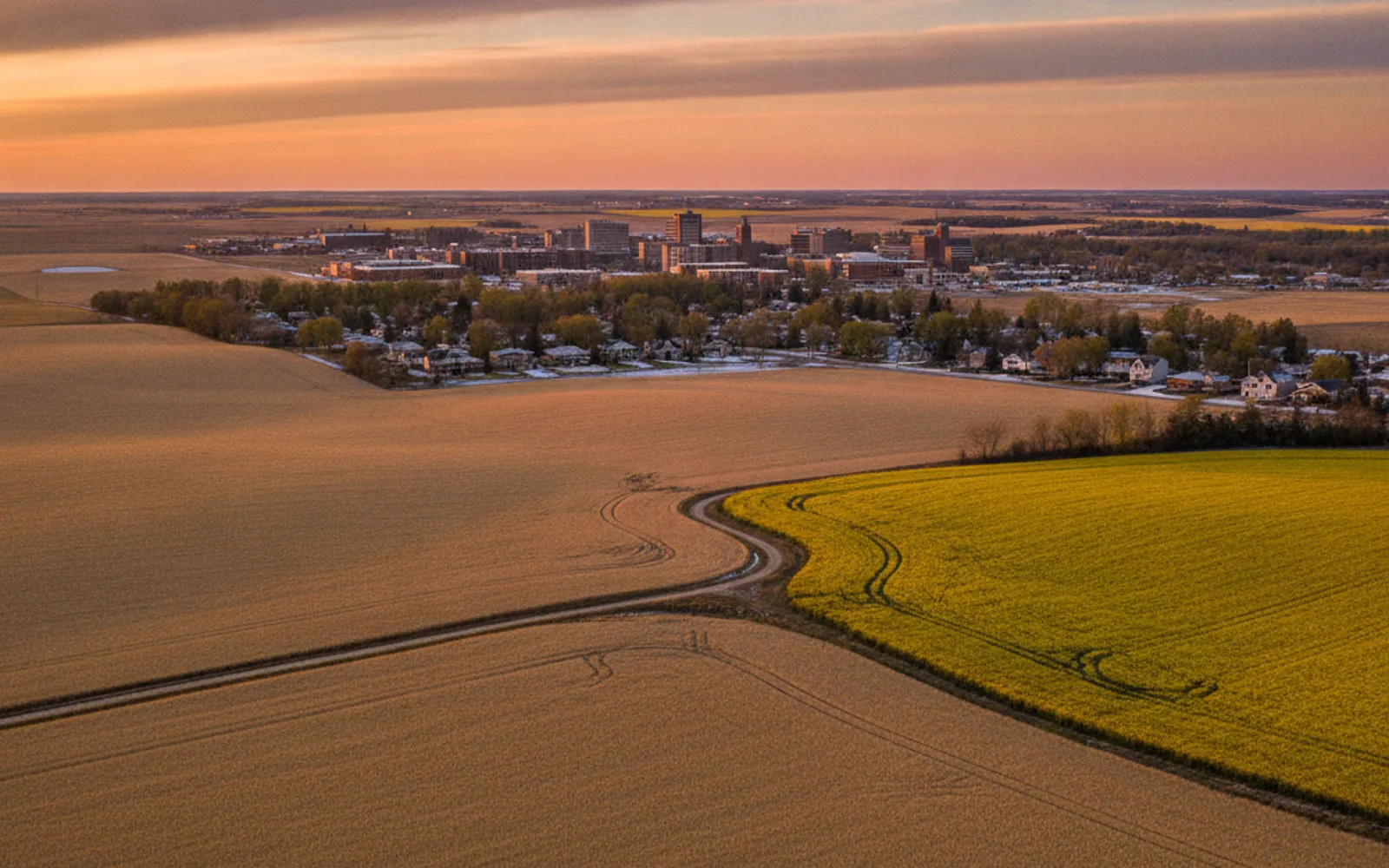
Brandon has turned up some of the higher radon results in Manitoba's surveys. A three-month test in your basement tells you where your own house sits.
Brandon and the Westman towns around it show up near the top of Manitoba's radon surveys. In Health Canada's 2012 survey, 44.3% of the homes tested in the Brandon health region were above 200 Bq/m3, the highest share in either Manitoba or Saskatchewan. The 2024 Cross-Canada survey found 36.1% of the Brandon homes it tested at or above that level, from a small sample of homeowners who chose to test.
None of that tells you what's in your house. Radon has no colour or smell, and the only way to know your number is a long-term test of at least 91 days in the lowest level you actually live in. If the result comes back high, we put you in touch with an independent C-NRPP certified professional who can look at the house and quote a fix. Call now on (204) 555-0173 if you'd like to talk it through first.
A test of at least 91 days, ideally over a Westman heating season, placed in the lowest lived-in level of your home. The Manitoba government puts long-term kits at between $50 and $100. How testing works.
If your Brandon result is over 200 Bq/m3, a certified mitigation professional can install sub-slab depressurization: a pipe through the basement floor, a fan, and a discharge outside. How a system works.
Buying or selling in Brandon with radon on the table? We explain your testing options and point you to your realtor or lawyer for conditions and holdbacks. Radon and real estate.
A noisy fan, a dead fan or a manometer that reads flat usually means the system has stopped pulling air. A certified professional can check it and retest. Fan problems.
Two surveys cover Brandon, and they measured different homes in different ways, so don't read them as a trend. The 2012 Health Canada survey found 44.3% of 79 tested homes in the Brandon health region above 200 Bq/m3, and 34.5% in the wider Assiniboine region around the city. The 2024 Cross-Canada survey put Brandon at 36.1% of the homes tested, with a geometric mean of 147.0 Bq/m3, and named Brandon among the Canadian cities where a quarter to half of homes are at or above 200.
A Bq/m3 (becquerel per cubic metre) is how radon in air is measured in Canada. Health Canada's guideline is 200 Bq/m3 as an average over the year, which is about 5.4 pCi/L if you're comparing with American sources. It is a guideline, not a law: no Manitoba rule makes a homeowner test or fix.
Why bother, then? Health Canada says radon is the number one cause of lung cancer in non-smokers and estimates it causes more than 3,000 lung cancer deaths in Canada each year. That's the whole case. It's common here, you can't see it, and a test is cheap.
Health Canada wants a test of at least three months, and 3 to 12 months is better. Put the detector in the lowest level someone spends four or more hours a day in, such as a finished basement or a basement bedroom, at least 30 cm off the floor and 30 cm from the walls. Keep it away from the sump, vents, windows and heat. A test that comes in under 91 days should be repeated.
Western Manitoba Regional Library, which has branches in Brandon, Carberry, Glenboro, Hartney and Neepawa, is a lending partner in the Manitoba Lung Association's detector programme. We couldn't find its loan length or season published, so ask at your branch. Library units are digital screening monitors: handy for a first look, but not a substitute for a proper long-term test.
Retest after a mitigation system goes in, after energy retrofits like new windows or air sealing, and if you finish a lower floor and start living in it. More on testing.
We found no mitigation price published by a Brandon contractor, so we won't make one up. The nearest real figures: Winnipeg installers advertise systems from about $1,500 to $3,000, and a Regina installer quotes $2,500 to $3,500. Health Canada's national range from 2014 is $2,000 to $3,000. A certified professional who has seen your basement will give you the only number that matters. Cost breakdown.
Two programmes can help Manitoba households. The Manitoba Lung Association runs Lungs Matter, which pays up to $1,500 toward mitigation for low- or moderate-income households; you need a 90-plus day C-NRPP test over 200 and a C-NRPP quote, the work can't already be done, and funding is limited. Manitoba Hydro's Home Energy Efficiency Loan covers radon mitigation up to $5,000 over five years at 6.2% (O.A.C.) on your energy bill, with no income test, as long as the contractor is C-NRPP certified.
Built since 1 April 2011? Manitoba homes built under the code since then should have a radon rough-in: a pipe below the basement floor, sealed and labelled. The rough-in does not lower radon by itself. It only makes a fan easier to add if your test comes back high.
The surveys can't settle that. In 2024, 36.1% of the Brandon homes tested and 37.4% of the Winnipeg homes tested were at or above 200 Bq/m3, but the Brandon sample was small and neither figure is weighted. Both cities are clearly high enough that testing makes sense.
Western Manitoba Regional Library is a partner in the Manitoba Lung Association lending programme, with branches in Brandon, Carberry, Glenboro, Hartney and Neepawa. We couldn't find published loan terms, so check with your branch. A borrowed digital monitor is a screening tool; follow it with a long-term test of 91 days or more.
We found no Manitoba rule that requires radon testing or disclosure at sale. Buyers can still ask for a test as a condition. Talk to your realtor or lawyer about conditions and holdbacks, and see our page on radon and home sales.
Health Canada recommends a C-NRPP certified mitigation professional. Certification is voluntary and belongs to the individual, so look them up in C-NRPP's online directory before you sign anything. Call (204) 555-0173 and we'll connect you with an independent certified professional who can quote your house.
No-obligation quotes from independent certified radon professionals.