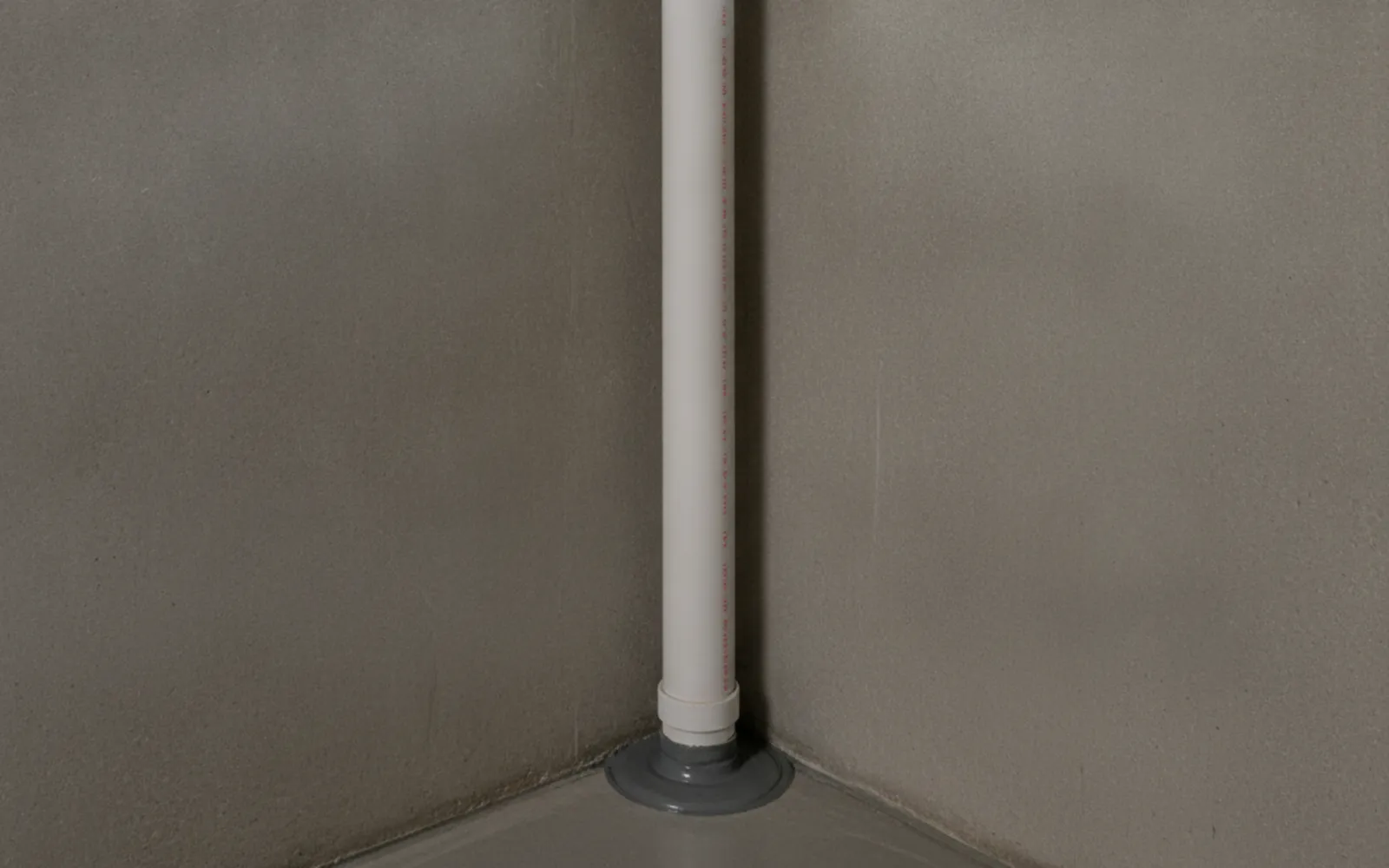
A pipe through the basement slab, a fan that runs around the clock, and a retest to prove it worked. Here is how a radon mitigation system goes in, what Prairie installers advertise, and what it costs to keep running.
Radon mitigation in Winnipeg almost always means one thing: sub-slab depressurization, also called active soil depressurization. A pipe goes through the basement floor into the gravel or soil underneath, a fan pulls air from under the slab, and the radon is vented outside before it can seep into the house. Health Canada says this kind of system will reduce radon by more than 80% in most homes.
The Canadian guideline is 200 Bq/m3 (becquerels per cubic metre, a measure of radioactivity in the air), and it is a Health Canada guideline, not a law: neither Manitoba nor Saskatchewan makes you test or fix. If a long-term test in your lived-in basement comes back above 200, Health Canada recommends fixing it within one year. Haven't tested yet? Start with a long-term test, because a mitigation quote without a proper result is guesswork.
A careful installer checks how well suction travels under your slab before deciding how many suction points you need and where they go. One point is common; a slab that breathes poorly may need more.
An open sump is a wide-open radon entry point. It gets an airtight cover, and if a floor drain feeds it, a trap goes in so the sump still drains water without leaking soil gas.
Health Canada warns that a fan and pipe in a cold garage or attic can gather condensation and ice. An indoor fan with a short exhaust near ground level cuts that risk, so the placement should be argued out before the install.
The system only works while the fan runs, so it is wired to run continuously. Health Canada is blunt about it: the fan should never be turned off.
A U-tube manometer on the pipe shows whether the fan is pulling suction. If the liquid in the two sides sits level, something has stopped working.
A short-term test after the fan is turned on, then a long-term test the first heating season in the same spot as your original test. Then a retest every five years.
Radon gets in because the air pressure inside a house is usually a little lower than in the soil around the foundation. Soil gas is drawn in through cracks, construction joints, gaps around service pipes and support posts, floor drains and sumps. A sub-slab system flips that: the fan keeps the space under the slab at lower pressure than the basement, so soil gas goes up the pipe instead of into the room.
The job usually runs in this order:
Health Canada says a system can usually be installed in less than a day, and recommends a C-NRPP certified mitigation professional. You can look up anyone who quotes you in C-NRPP's online directory. Call (204) 555-0173 to talk through your result and line up a quote.
There are two basic routes. The fan can sit indoors near the rim joist with a short pipe venting sideways at ground level, or it can sit in the attic or an attached garage with the pipe running up to discharge above the roof. Health Canada describes both. The catch on the Prairies is cold: a fan and pipe outside the heated space cool down in winter, which can lead to condensation and ice that can damage the fan.
In a bungalow the run from basement to attic is short, so an above-roof exhaust is often practical, usually up through a closet or the garage. In a two-storey that same route means a long climb through finished walls or up the outside of the house, so a rim-joist exit near grade is often simpler and stays warmer. Wherever it ends, the exhaust has to sit where the gas can't drift back in through a window or door. Ask the installer where they want it and why before anyone cuts a hole.
Newer homes may have a head start. Radon rough-ins entered the National Building Code in 2010 (Manitoba adopted it on 1 April 2011), but a capped pipe under the slab does nothing until a fan is added. A 2013 study of Winnipeg Parade of Homes houses found almost half the rough-ins were in inaccessible locations, so have the installer confirm yours can be used.
Winnipeg installers advertise systems from about $1,500 to $3,000; a Regina installer quotes $2,500 to $3,500. Those are what individual companies publish on their own sites, before tax, not a set local price. One Winnipeg installer adds 20% for off-season installs (30 November to 20 May), and the Regina installer says crawl spaces or multiple suction points can cost much more. Health Canada's national figure, from 2014, was $2,000 to $3,000.
We found no published mitigation price for Saskatoon, Brandon, Moose Jaw or Prince Albert. If you are in one of those places, a certified professional will quote the job after seeing the house. See the full cost breakdown for what pushes a quote up or down.
There is some help with the bill:
There is currently no federal radon tax credit that we could find.
A new system isn't finished until a test says so. Health Canada's current advice is a short-term test by a certified professional once the fan is on, to confirm levels are below 200 Bq/m3; then a long-term test during the first heating season, in the same spot as your original test; then a retest every five years. Retest too after an energy retrofit or if a lower floor becomes living space.
Day to day, glance at the manometer now and then. A difference in the liquid level between its two sides means the fan is pulling suction. If the sides are level, the fan has stopped or something has come loose, and it's time to read up on fan replacement.
Health Canada estimates a radon fan lasts five to ten or more years, costs $200 to $300 to replace, and uses about $50 to $75 of electricity a year. Those are national figures from 2014, not current Prairie prices, so treat them as a rough guide. And don't switch the fan off to save power: the system only works while it runs.
Winnipeg installers advertise systems from about $1,500 to $3,000, before tax. One Winnipeg installer adds 20% for off-season work between 30 November and 20 May. Your own quote depends on the slab, the sump and how many suction points the house needs, so get it in writing from a C-NRPP certified professional.
No. The 200 Bq/m3 figure is a Health Canada guideline, not a legal limit, and neither province requires homeowners to test or mitigate. Health Canada recommends fixing a home above 200 within one year, and says there is no level that is considered risk free.
Health Canada says active soil depressurization will reduce radon by more than 80% in most homes, and its September 2026 factsheet puts it at 90% or more. The only way to know what it did in your house is to retest: a short-term test after the fan is on, then a long-term test the first heating season.
Neither is a fix. Health Canada says sealing is not a standalone technique for reducing radon, though it helps a fan system work better. Heat recovery ventilators generally cut radon by only 20% to 50%, which is why active soil depressurization is the usual recommendation when levels are high.
Health Canada's 2014 national estimate is about $50 to $75 a year in electricity. Fans last five to ten or more years and cost $200 to $300 to replace, again by Health Canada's 2014 figures. Check the manometer now and then and retest every five years.
No-obligation quotes from independent certified radon professionals.