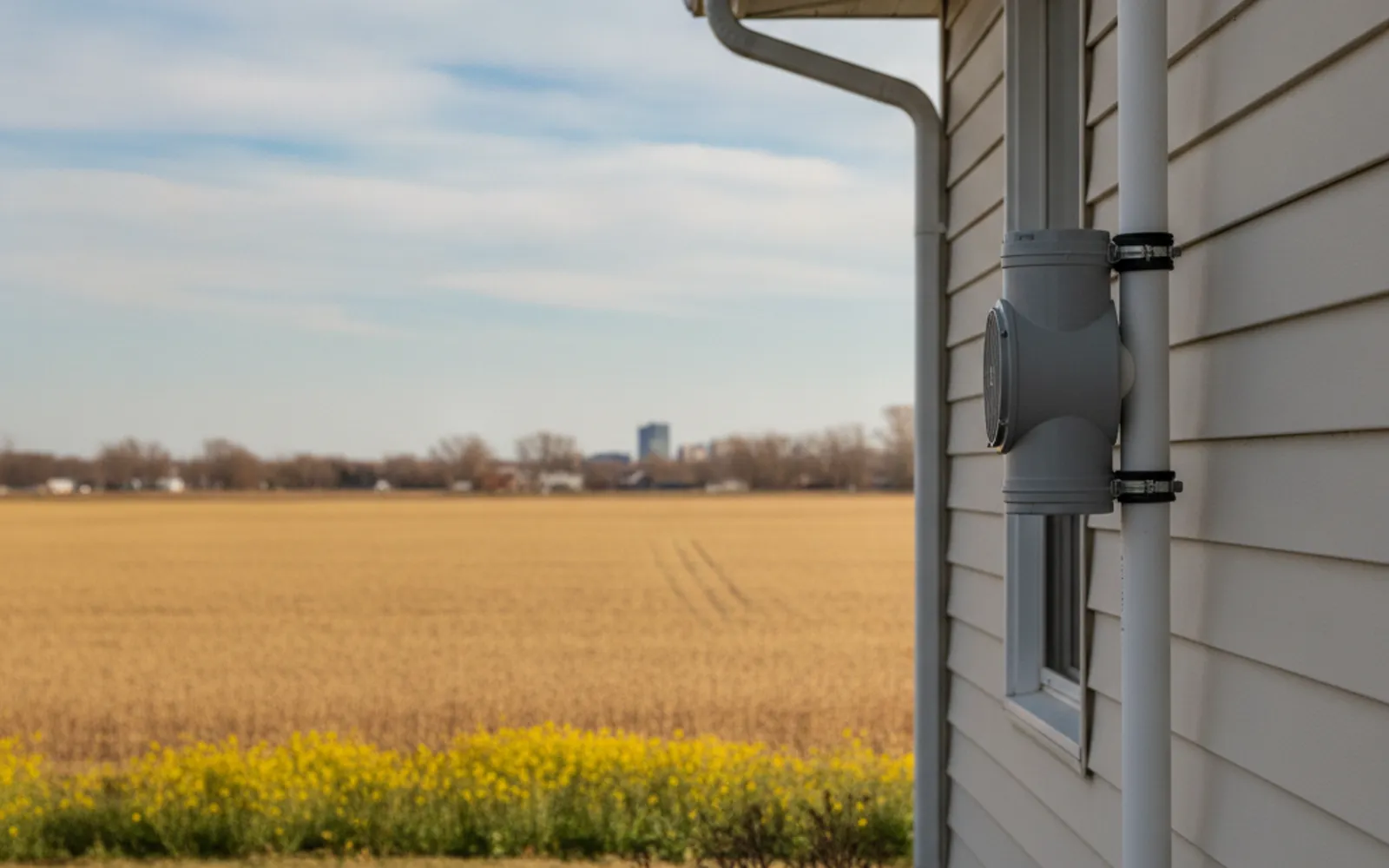
Noisy fan, dead fan, or a manometer that reads level? A certified radon professional can find out why, swap the fan if it needs it, and tell you when to retest.
Radon fan replacement is the most common repair on an existing radon system, because the fan is the only part that moves. The pipe, the sealed slab and the sealed sump just sit there. The fan runs day and night, every day of the year, and Health Canada says it should never be turned off. Sooner or later it wears out.
This page is for Winnipeg, Regina and Saskatoon homeowners (and everyone in the towns around them) who already have a system, or who have a capped radon pipe in the basement floor that nobody ever connected. We put you in touch with an independent radon professional who checks the whole system, not just the fan, and quotes the job. If you have no system and no test yet, start with a long-term radon test instead.
The failed fan comes out and a replacement sized for your pipe and suction points goes in. The rest of the system stays put.
The U-tube manometer on the pipe is read and checked. If both sides of the liquid sit level, the system isn't pulling and the professional works out why.
A rattle or hum can be a worn fan, a loose mount or pipe touching the framing. Only one of those needs a new fan.
Health Canada warns that fans in garages and attics can collect condensation and ice in the cold months, which can damage the fan. That matters here.
Newer homes often have a capped radon pipe under the basement floor. A fan and exhaust piping turn it into a working system, if a test says you need one.
After a fan swap or a basement renovation you get clear advice on which test to run, where to put it and for how long.
Health Canada's 2014 radon reduction guide puts a fan's lifespan at five to ten or more years. That's a national figure, not a Prairie one, and plenty of fans outlast it. Plenty don't, either.
The signs are usually plain once you know to look:
Health Canada's 2014 national estimate for a replacement fan is $200 to $300, and about $50 to $75 a year in electricity to run one. We found no current Manitoba or Saskatchewan price for a fan swap, so the professional who looks at your system will quote it.
The manometer is the small U-shaped tube of coloured liquid mounted on the radon pipe, usually in the basement. When the fan is pulling, the liquid sits higher on one side than the other. When both sides are level, there's no suction in the pipe.
Health Canada says to check it from time to time. An easy habit is to look at it whenever you change the furnace filter. A level reading can mean a dead fan, but it can also mean a tripped breaker, an unplugged fan or a pipe that's come apart, so check those first before you call.
One thing the manometer can't tell you is your radon level. It shows the fan is moving air. Only a test shows what's in the room.
A radon rough-in was added to the National Building Code in 2010. Manitoba adopted it on 1 April 2011, and the 2020 codes have been in force in both Manitoba and Saskatchewan since 1 January 2024. Under the 2020 code, homes get a subfloor depressurization rough-in: commonly a 100 mm pipe below the basement floor, sealed and labelled.
The catch, as the City of Regina puts it: "the depressurization rough-in does not actively reduce radon levels". A fan has to be added before it does anything. It's also not always easy to reach. A 2013 study of Winnipeg Parade of Homes houses found rough-ins in all but one house, and almost half were in inaccessible locations.
Test before you activate. Health Canada recommends a long-term test of at least 91 days in a new home during the first heating season after you move in. If the average comes back over 200 Bq/m3 (becquerels per cubic metre, Health Canada's guideline), activating the rough-in is often the simplest route to a working mitigation system. If it comes back low, the pipe can stay capped.
Radon is the leading cause of lung cancer in non-smokers, according to Health Canada, which is why a fan that quietly stopped months ago is worth a look. A proper visit covers more than the fan. Ask for these on the written quote:
Health Canada recommends a C-NRPP certified mitigation professional. Certification belongs to the person, not the company, so check their name in C-NRPP's online directory before you book. After the work, Health Canada's steps are a short-term test by a certified professional, a long-term test in the first heating season in the same spot as your original test, then a retest every five years. Retest sooner if you finish the basement so a new floor becomes the lowest lived-in level, or after an energy retrofit. Ready to book a check? Call now on (204) 555-0173, or see what a full system costs if yours can't be saved.
Health Canada's 2014 guide says a fan's lifespan can vary between five and ten or more years. That's a national estimate, and the real life depends on where the fan is mounted and how it was installed. Fans in cold garages and attics face condensation and ice in winter, which can shorten their life.
We couldn't find a current published fan-swap price for anywhere in Manitoba or Saskatchewan. The only figure we have is Health Canada's 2014 national estimate of $200 to $300 for a replacement fan, plus about $50 to $75 a year in electricity. A radon professional will quote your job after looking at the system.
Level liquid means the system isn't pulling air from under the slab. Check the breaker and the fan's plug, and look for a pipe joint that has come apart. If all of that is fine, the fan has likely failed. Don't leave it off: Health Canada says the fan must run continuously for the system to work.
It's worth it. Health Canada says homes with active systems should be retested every five years, and also after energy retrofits or when a floor that wasn't tested becomes the lowest lived-in level. A long-term test should run at least 91 days in the heating season, and the result is compared to the 200 Bq/m3 guideline. See radon testing for how to set one up.
No. The building code's rough-in pipe does not actively reduce radon on its own; a fan has to be added. Manitoba has required the rough-in since 1 April 2011. Run a long-term test of at least 91 days first, and activate the pipe only if the result is over 200 Bq/m3.
No-obligation quotes from independent certified radon professionals.